
A VoIP phone can be a one-time hardware purchase, while the VoIP service commonly adds a recurring monthly subscription, usage charges, or both. For business accounts, published 2026 pricing commonly places hosted service around $15–$30 per user or line each month, before taxes, equipment, international calls, and optional features.
The final VoIP phone monthly cost depends on the billing unit, plan, destination, device, and country. A household may pay for one line, while a business may pay per licensed user, extension, phone number, or feature tier.
Quick facts
💡 The phone itself may be a one-time cost. The service usually creates the recurring charge.
📞 Business VoIP commonly costs about $15–$30 per user or line monthly in published market estimates, with provider and billing conditions attached.
⚠️ Internet access is usually separate. Taxes, emergency-service charges, numbers, and international calls can increase the bill.
🧾 Compare the first-year total. Monthly service, equipment, setup, usage, and cancellation terms matter together.
Does a VoIP Phone Have a Monthly Charge?
Yes, a VoIP phone may involve a monthly charge when it uses a hosted VoIP service, although the handset, adapter, application, or headset can be purchased once. A VoIP service is a communications subscription that routes calls through an internet connection instead of a traditional telephone network.
Therefore, separate these costs before comparing tariffs. The physical endpoint may be bought, rented, or avoided through a computer or mobile application. The recurring service may use one of three billing models:
- Monthly subscription: a fixed account, line, or user charge.
- Pay-as-you-go credit: usage is deducted from prepaid or funded credit.
- Bundled allowance: a plan includes a defined amount of calling, with extra usage billed separately.
Internet access is usually a separate household or business expense. A VoIP subscription does not automatically provide broadband, Wi-Fi, backup connectivity, or electrical power.
Taxes and regulatory charges can also follow the billing address, customer type, and country. Emergency calling may have a separate charge, while local numbers, premium destinations, and international routes can carry their own prices.
Typical VoIP Monthly Costs for Home and Business
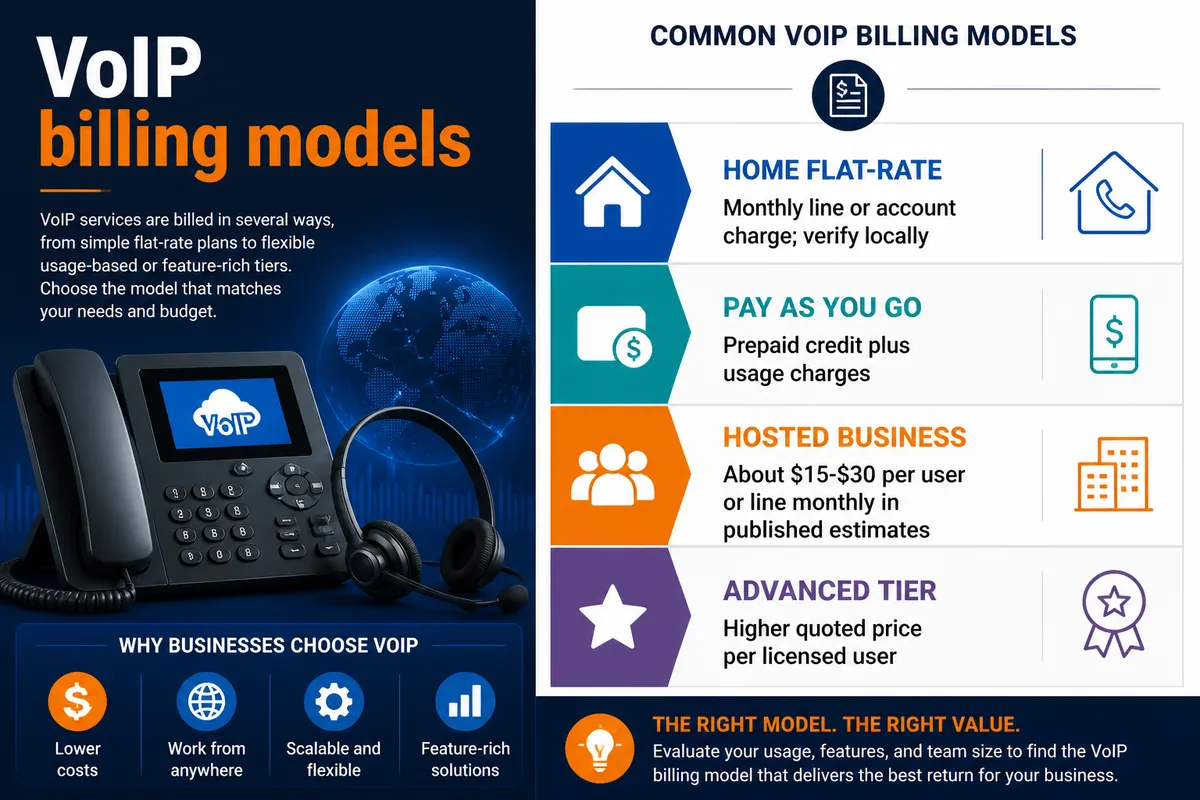
Typical business VoIP pricing commonly falls around $15–$30 per user or line each month in published market estimates, while the home VoIP cost may use a flat line fee, prepaid credit, or an app-based tariff. These figures are indicative, not universal, and must be checked against dated provider terms for the relevant country.
Therefore, the displayed headline price needs a billing-unit check. A business quote may cover one licensed user with applications and administration, while a residential plan may cover one household number with domestic calling.
| Post or service | Indicative range or structure | What changes the final amount |
|---|---|---|
| Home flat-rate plan | Monthly line or account charge; verify locally | Country, included destinations, number, taxes, and contract |
| Pay-as-you-go home service | Prepaid credit plus usage charges | Destination, minute rate, minimum balance, and number fees |
| Hosted business VoIP | About $15–$30 per user or line monthly in published estimates | Users, features, billing term, support, taxes, and usage |
| Advanced business tier | Higher quoted price per licensed user | Recording, analytics, integrations, routing, and support level |
| Additional number or extension | Separate recurring or one-time charge; verify provider terms | Geographic availability, number type, user licensing, and porting |
Published provider examples illustrate the spread without defining the whole market. A 2026 Nextiva-oriented pricing presentation lists $15–$25 per user monthly for small teams and $25–$45 for certain mid-sized advanced plans; Dialpad pricing is presented at $15 and $25 per user monthly for named plan levels, subject to billing conditions.
The $20–$30 per-user monthly range is commonly repeated by several pricing sources for hosted business VoIP. That range remains an attributed estimate, not an official market average.
Home VoIP plans and pay-as-you-go options
Home VoIP plans generally trade predictable billing for a recurring line charge, while pay-as-you-go services reduce commitment for occasional callers. A home plan may include a number, incoming calls, and common features, yet destination rules and emergency-service treatment vary by market.
Therefore, frequent domestic callers usually need a flat-rate comparison. Occasional callers should inspect prepaid credit expiry, minimum charges, number fees, and international rates.
Some app-based alternatives use a mobile or computer instead of a dedicated handset. They can reduce equipment spending, while number portability, emergency calling, and incoming-call availability require separate verification.
Business VoIP pricing per user
Business VoIP pricing reflects more than call transport because the subscription may cover users, extensions, applications, routing, administration, and support. A licensed user, a direct phone number, and an extension can represent separate billable units.
Common cost multipliers include user count, advanced call handling, recording, analytics, integrations, and higher support levels. A small team may pay a published per-user rate, while a larger deployment may receive a quote based on volume and requirements.
Published plan examples also show why identical-looking prices can mislead. One tariff may include 3,000 minutes per user monthly at €29 excluding VAT for an Essentials tier, while a Professional tier may include the same allowance at €39 excluding VAT; accounts with 16 or more users may be directed to custom pricing. Verify the original tariff before relying on those figures.
What a VoIP Monthly Fee Usually Includes—and What It May Exclude
A VoIP monthly fee commonly includes the service account and a defined set of calling features, but the headline price does not guarantee unlimited destinations, taxes, hardware, or emergency calling. The useful comparison is the complete inclusion list attached to the specific plan and location.
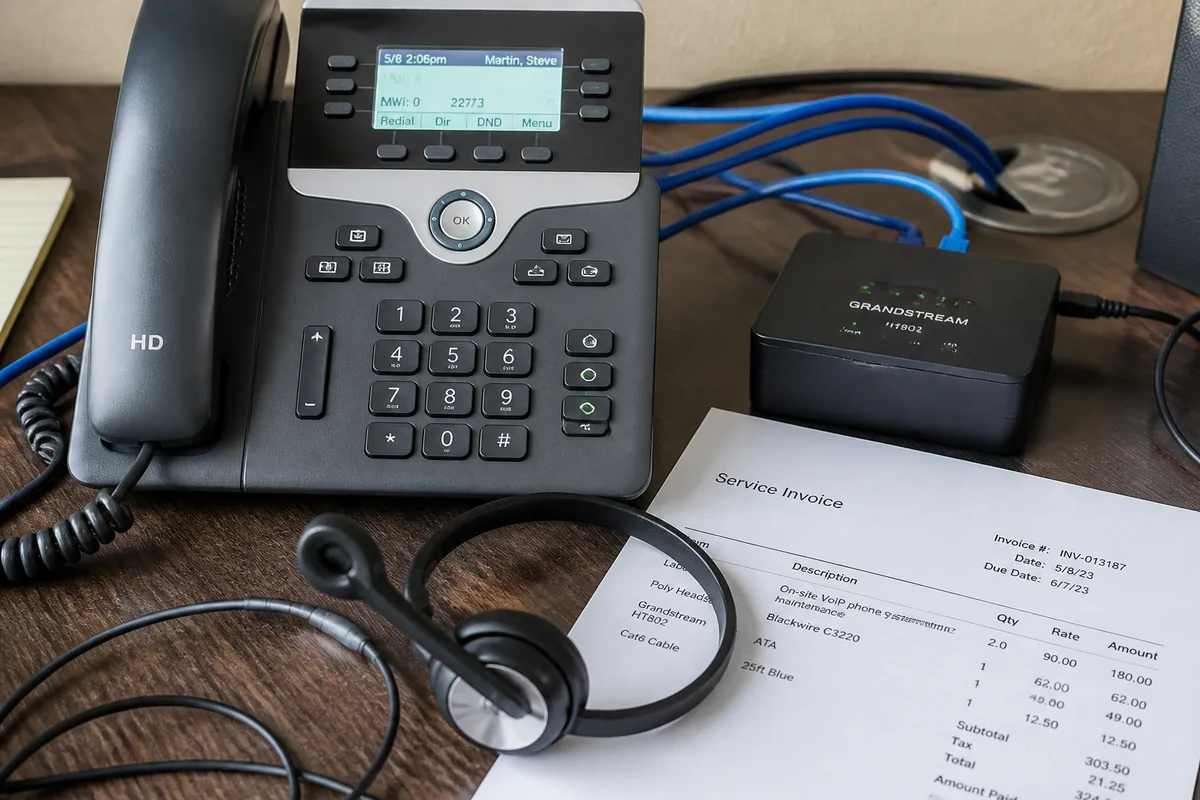
Therefore, read the plan as an itinerary for an actual call. The number is assigned, the call reaches its destination, and each stage can create a separate charge.
Services commonly bundled with a subscription
Consumer plans may bundle a virtual number, incoming calls, voicemail, caller ID, call forwarding, and softphone access. Business tiers may add extensions, queues, basic routing, and administrative controls when those features are included at the selected level.
Support is another dividing line. A consumer account may provide self-service help, while a business account may attach a higher support tier or service-level commitment.
Unlimited calling also needs a destination check. Geographic exclusions, fair-use rules, mobile termination, international routes, premium numbers, and special services may sit outside the advertised allowance.
Charges that often appear as add-ons
Add-ons may include extra numbers, users, extensions, international packages, out-of-bundle minutes, recording, transcription, analytics, CRM integrations, and advanced routing. Taxes, regulatory assessments, emergency-calling charges, equipment rental, and service fees may appear separately.
Therefore, ask for the price before tax and the final price after tax. Ask for both monthly and annual totals.
One-Time and Separate Costs That Affect the First-Year Total
The first-year VoIP cost can exceed the advertised monthly rate because equipment, activation, installation, number porting, connectivity upgrades, and power backup may be billed separately. VoIP service does not provide an internet connection by itself, so existing broadband and new connectivity must be treated separately.
Therefore, a low monthly tariff is not the right decision when it requires expensive hardware or a new connection. Count mandatory switching costs first.
Equipment, activation, and installation
An IP phone, analog telephone adapter, headset, compatible router, and power backup can be purchased, rented, or already available. Existing analog phones may work through an adapter, while a softphone application can remove the need for a dedicated handset.
Activation, provisioning, professional installation, and configuration may carry separate charges, especially for multi-user business deployments. Some hosted services allow self-service setup without a setup fee, while network work or physical installation can still create a cost.
Hardware is a one-time cost only when it is bought outright. Rental equipment remains a recurring line item.
Number porting, call usage, and connectivity
Number porting may be included, charged separately, delayed, or unavailable, depending on the provider, country, number type, and account documentation. International, premium-rate, directory, and excluded destinations can be billed by the minute even when domestic calling is unlimited.
Reliable broadband belongs in the real budget when the existing connection cannot support the intended service. A backup connection and power resilience may also matter for a business that cannot tolerate a dead router or local outage.
Small businesses should calculate the monthly share of equipment and setup across a realistic ownership period. That method prevents a cheap first invoice from hiding a costly deployment.
VoIP vs. Landline vs. Mobile: Compare the Total Cost, Not Just the Monthly Line
VoIP can lower communication costs when reliable internet is already paid for, several extensions share one service, and included destinations match actual calling patterns. A landline can remain practical where internet reliability is poor, while mobile service may suit one user who values portability over desk-phone features.
Therefore, VoIP suits an office with stable broadband and flexible routing. A mobile plan suits a traveling individual. A landline suits a location where local resilience matters more than application features.
| Option | Recurring service | Equipment and connectivity | Best fit | Cost warning |
|---|---|---|---|---|
| VoIP | Account, line, user, or usage billing | Internet, handset, adapter, and backup may be separate | Connected homes and flexible businesses | Excluded destinations and add-ons |
| Landline | Line and calling charges | Dedicated telephone equipment and installation | Locations prioritizing traditional service | Installation and feature limitations |
| Mobile | Mobile account or prepaid usage | Handset, battery, and mobile network | Portable individual calling | Data, roaming, or business administration costs |
Do not choose VoIP for the lowest headline price alone. Choose it when the full route—network, device, provider, destination, and fees—fits the way calls actually travel.
How to Calculate Your Real VoIP Monthly Cost
The reusable calculation is: service subscription plus user or line charges, feature add-ons, expected usage, taxes and fees, and the monthly share of upfront equipment costs. Add internet service only when VoIP requires a new or upgraded connection for the household or business.
Therefore, start with the billable unit. Then trace one expected call from the device through the network to its destination, including any surcharge created along that route.
Illustrative home budget: use the provider’s line charge as the base, add any number or emergency-service fee, add expected calling credit, and spread a one-time adapter purchase over the intended ownership period. Replace every placeholder with the current tariff for the billing address.
Illustrative small-business budget: multiply the monthly user price by licensed users, then add direct numbers, shared extensions, desk phones, headsets, setup, feature tiers, integrations, support, usage, and regulatory charges. A five-user example is only a calculation model, not a market quotation.
Home VoIP cost checklist
Home users should record the account or line subscription, equipment purchase or rental, calling credit, taxes, emergency-service charges, and optional features. Internet belongs in the calculation only when it is a new or necessary upgrade.
- Confirm whether the number is included.
- Check incoming and outgoing destinations.
- Record minute limits and out-of-bundle rates.
- Compare promotional and post-promotion prices.
- Check cancellation and equipment-return terms.
Small-business VoIP cost checklist
Business users should count licensed users, direct numbers, shared extensions, desk phones, headsets, setup, feature tiers, integrations, support, and regulatory charges. Spread deployment costs across a realistic ownership period instead of treating the first invoice as the monthly norm.
-
Normalize the quote
Convert account, line, user, extension, and number charges into separate rows.
-
Separate usage
Estimate international, premium, and excluded-destination calls outside included minutes.
-
Spread upfront costs
Divide hardware, installation, and setup across the expected ownership period.
-
Recheck contract terms
Review minimum licences, renewal conditions, cancellation, and user changes before signing.
How to Avoid Unexpected VoIP Charges Before You Subscribe
Unexpected VoIP charges usually come from a mismatch between the advertised unit and the actual bill, a promotional rate that expires, excluded destinations, or features treated as add-ons. Verify the price, allowance, billing frequency, contract, and location-specific fees before committing.
Therefore, request a complete quote rather than a headline tariff. A complete quote names the payer, the endpoint, the network, and the call destination.
- Promotional pricing: identify the standard renewal price and the end of the introductory period.
- Billing unit: confirm whether the charge applies per account, line, number, extension, user, or concurrent call.
- Calling policy: check destinations, minute limits, fair-use rules, international rates, and premium numbers.
- Tax treatment: ask whether displayed prices exclude VAT, sales tax, or other local charges.
- Activation and porting: confirm setup, number migration, documentation, and delay conditions.
- Cancellation: read minimum terms, renewal, downgrade, equipment return, and termination rules.
For businesses operating across countries, the final invoice can also reflect the billing address, currency conversion, and local VAT treatment. Published VAT references describe rates from 4.5% to 27.0% across listed jurisdictions, but that range cannot determine a VoIP invoice without the country, customer status, and place-of-supply rule.
Ask the provider for the tax rate shown on the invoice. Ask which country controls the billing address.
Frequently Asked Questions About VoIP Phone Charges
Is VoIP cheaper than a landline?
VoIP can cost less when reliable internet already exists and the plan covers the required destinations and features. Equipment, taxes, installation, international usage, and backup connectivity can narrow or remove the difference, so compare first-year totals.
Can I use VoIP without a monthly subscription?
Yes, pay-as-you-go credit, prepaid services, and some app-based options can avoid a fixed monthly subscription. Those options may limit numbers, incoming calls, emergency calling, features, or account availability in a particular country.
Do I need to buy a special VoIP phone?
No. A service may work through an IP desk phone, an analog adapter with an existing phone, a computer, or a mobile application. The chosen endpoint changes the equipment cost and sometimes the supported features.
Are incoming and international calls included with VoIP?
Incoming and domestic calls may be included under selected plans. International calls, premium destinations, mobile termination, and special services commonly follow separate country-specific rates or package rules.
Are taxes and emergency-calling fees included in the advertised price?
They may be itemized separately from the advertised service price. Check the current provider price sheet and the local requirements for the service address before treating the headline amount as the final bill.
What to remember
- Separate hardware from service. A handset may be bought once, while the account remains recurring.
- Normalize the billing unit. User, line, extension, number, and account prices are different.
- Trace the call destination. International and special routes can create usage charges.
- Calculate the first year. Include equipment, setup, connectivity, taxes, and contract conditions.
The meaningful answer is not one advertised monthly rate. The reliable comparison is the complete first-year cost after service, calling, hardware, connectivity, fees, and contract conditions are counted; check the current tariff before subscribing and trace every destination before calling.