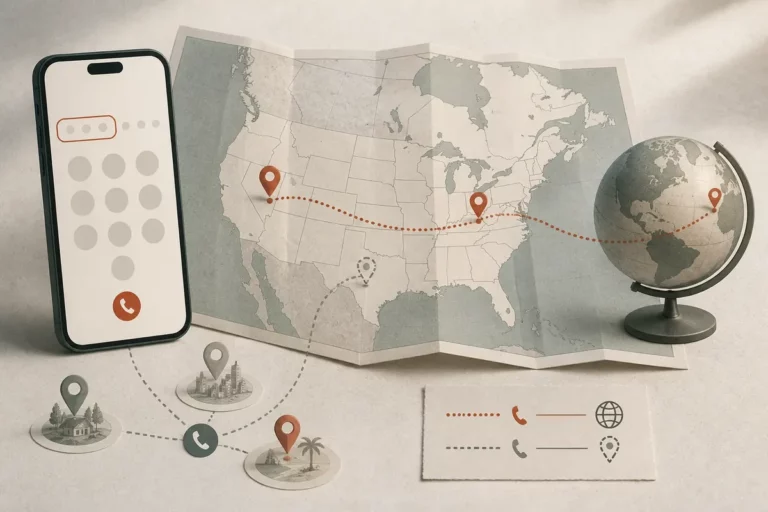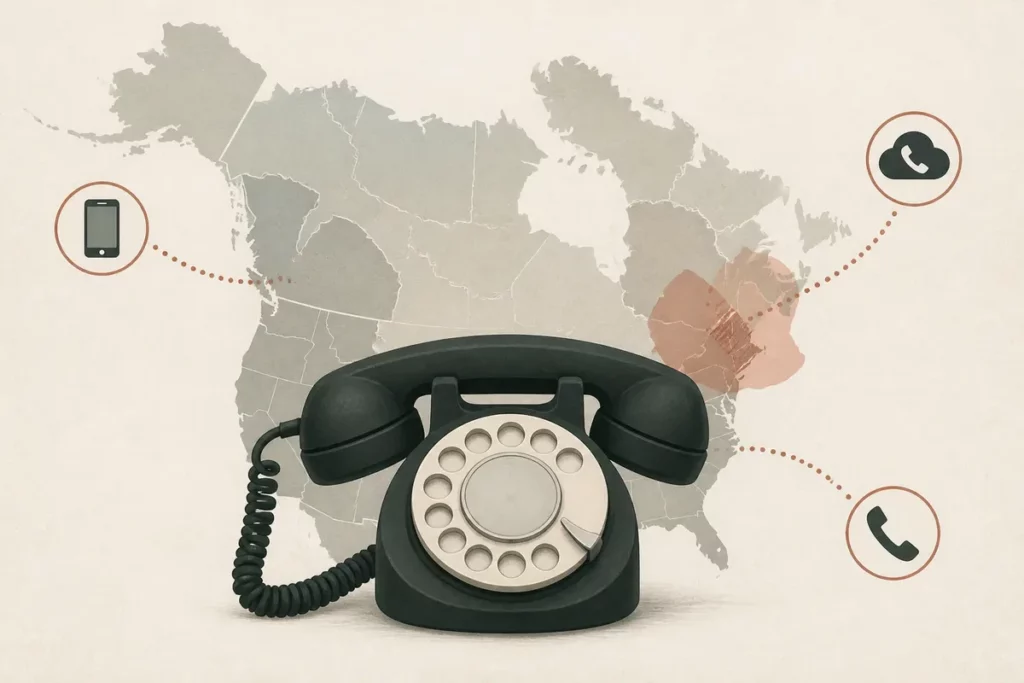
Three digits can point to a planned numbering region, but area codes are not random selections. In the North American Numbering Plan, geographic codes were assigned to broad service areas, while overlays, mobile use, virtual numbers, and portability now weaken the link with a caller’s present location.
To find an area code by location, search by country, state, province, territory, city, or region. Treat the result as a geographic association rather than proof of a caller’s current whereabouts, because the original assignment may differ from the person’s location today.
Key facts
📍 Geographic area codes identify broad numbering regions, not exact addresses or neighborhoods.
🔢 Overlays allow several codes to serve the same city or metropolitan area.
📱 Number portability and virtual services can separate a phone number from its original location.
⚠️ Caller ID can be spoofed, so a familiar local code cannot authenticate a caller.
Are area codes assigned to specific locations?
Yes. A geographic area code is a three-digit numbering-plan assignment linked to a broad region, such as several communities, a metropolitan area, or a large territory. The assignment is planned rather than random, although the code rarely identifies an exact address or a caller’s present location.
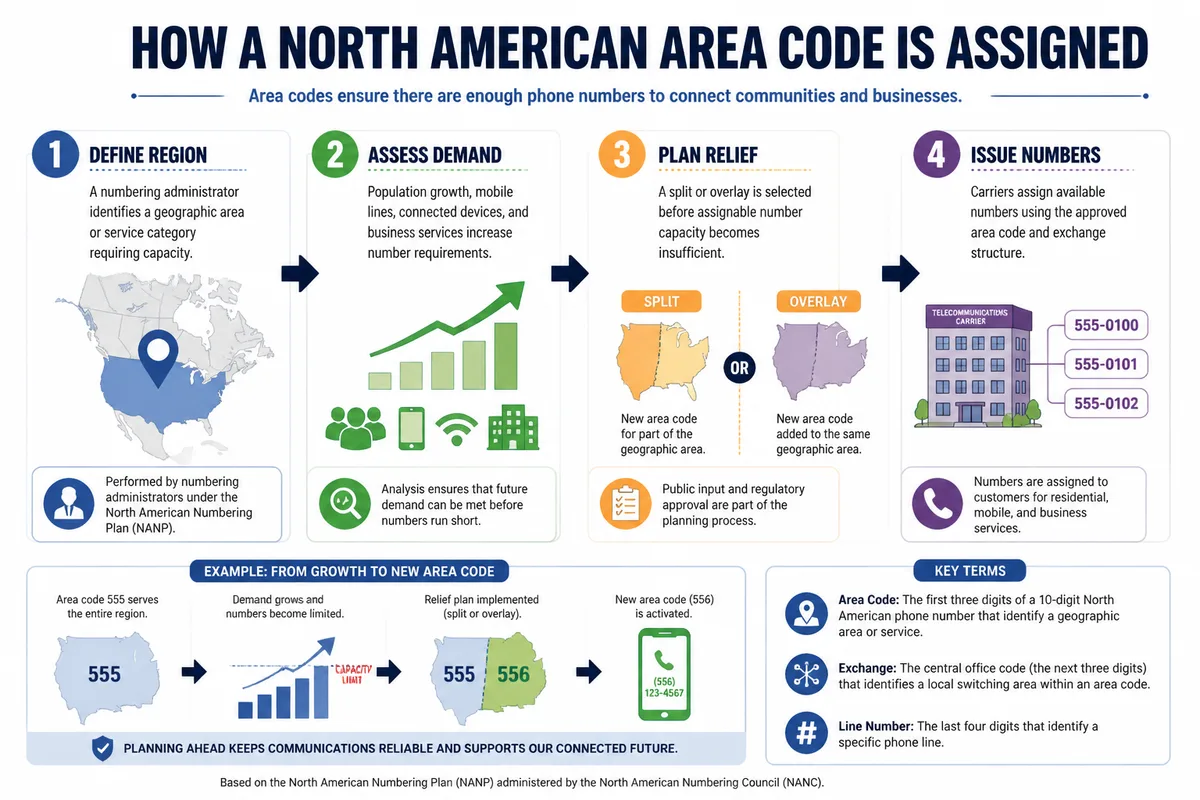
The original numbering region is the useful starting clue. Area codes were designed to organize telephone numbers across defined geographic areas within the North American Numbering Plan. A code can cover one major city, several nearby cities, or a wide rural territory.
Therefore, an area code may tell you where a number was originally issued. It cannot establish where the subscriber lives now. A person may retain the number after moving, and a business may select a local-looking number for customers in another market.
What a geographic area code can reveal
And a geographic code can identify the broad region associated with the number when it was assigned. For example, directory references consistently associate area code 201 with parts of New Jersey, including Jersey City and Hackensack, while area code 202 is associated with Washington, D.C.
Those examples describe regional associations, not precise subscriber locations. Several communities can share one code. A lookup organized by state, province, territory, or city is more useful than reading the digits as a coded address.
- A broad original numbering region.
- A geographic service code rather than a toll-free code.
- A possible association with several nearby communities.
What it cannot reveal
Yet an area code cannot reveal an exact street address, current city, or real-time caller location. The number may belong to a mobile user, a cloud phone system, or a business serving customers far from its registered office.
One common belief sounds plausible: “A local area code means the caller is local.” The call route breaks that assumption. A number may have been assigned locally, transferred to another carrier, moved across the country, or presented through an internet calling platform.
Why area codes exist and how new ones are assigned
Area codes exist to organize telephone-number capacity across regions and service types. Numbering administrators plan new assignments when available combinations become constrained by population growth, mobile lines, connected devices, and business services, rather than choosing digits as random labels.
And the North American numbering structure places the area code at the beginning of a standard ten-digit number. The next three digits identify a central-office or exchange prefix, followed by the individual line number.
Therefore, the complete number follows the broad pattern NPA-NXX-XXXX: the NPA is the area code, the NXX is the exchange prefix, and the final four digits identify the line. Customers can sometimes choose among available numbers, yet the available pool remains governed by the numbering plan.
New assignments can involve a geographic split, an overlay, or another approved numbering measure. The current status of a planned or newly introduced code should be checked with the relevant numbering administrator before publication.
Capacity planning concerns networks and number blocks. It does not rank cities by importance.
Why can one city have several area codes?
One city can have several area codes because the same geographic territory may receive additional numbering capacity through an overlay, while an earlier split may have divided an older region. Multiple codes usually describe numbering pressure or historical planning, not separate cities.
But two mechanisms produce different maps. A split redraws the numbering boundary and assigns different codes to different portions of the former region. An overlay adds another code across the same territory without removing the older code.
Area code splits divide a former numbering region
Yet a split separates an existing numbering area into two geographic zones. Numbers in the newly defined portion receive the new code, while many existing customers retain the older code attached to their lines.
A split can make regional boundaries somewhat clearer. It still cannot identify an exact location because the resulting zone may contain many communities, and later portability can move the number far from its original assignment.
Splits change geography.
Area code overlays add capacity without redrawing the map
And an overlay places a new area code over the same communities served by an existing code. Residents and businesses in one city can therefore receive different codes based on number availability, carrier allocation, and the timing of their service.
Ten-digit dialing commonly accompanies overlays because a seven-digit local number may no longer be unique across the shared territory. The exact dialing rule belongs to the local numbering authority, so a directory should display its verification date rather than assume one rule applies everywhere.
A newer local number may not match the code traditionally associated with its city. That mismatch is ordinary under an overlay.
Why may an area code fail to show where a caller is now?
An area code is best read as a clue about a number’s assignment history, not as proof of current whereabouts. Mobile portability lets customers retain numbers after changing carriers or moving, while virtual and business systems can present local-looking numbers from distant locations.
Therefore, a mobile area code may reflect a former hometown, workplace, college city, or first service address. The number can travel while the subscriber travels, and the original service area becomes less connected to daily physical location.
Number portability is the first practical check. Ask where the number was obtained, not only what carrier currently routes the call. Carrier and service conditions can affect portability, so the displayed code remains a historical clue rather than a live location signal.
Cloud phone systems create another gap. A company can route calls to employees in different places while presenting one local number to customers. A business may also choose a local presence in a market where it has no storefront.
Finally, caller ID can be spoofed. A displayed local code may be selected by the caller’s system or manipulated during the call path, which makes it unsuitable for confirming a company, locating an individual, or judging legitimacy.

Portability changes the meaning of mobile phone area codes
Yet a person may keep a mobile number from a former home after relocating. The area code stays attached to the number while the handset connects through networks in another region.
That is why a mobile area code cannot safely establish a subscriber’s current city. It can support a broad lookup, not a real-time location claim.
Virtual numbers and business phone systems
And a virtual number can route calls through software rather than a handset tied to the advertised region. Cloud systems may connect one local-looking number to staff working across several cities or countries.
A local-looking business number therefore describes an access choice. It may help customers reach a service, while offering little evidence about where the employee or company headquarters is located.
A local-looking caller ID is not verification
However, an area code alone cannot authenticate the caller. Spoofing can make an incoming call display a selected number, so independent verification matters whenever the request concerns credentials, payment, or urgent action.
Do not return a suspicious call using the displayed number. Find the organization’s official contact channel separately.
How do geographic area codes differ from toll-free codes?
Geographic area codes correspond to planned numbering regions, while toll-free codes identify a non-geographic service category. Codes such as 800, 833, 844, 855, 866, 877, and 888 can connect callers to businesses or services without identifying a dependable city, state, or territory.
| Numbering type | What it represents | Location clue | Practical limitation |
|---|---|---|---|
| Geographic area code | A defined numbering region | Broad original association | Overlays and portability reduce precision |
| Toll-free code | A non-geographic calling service | No dependable local region | Does not identify headquarters or caller location |
| Virtual business number | A hosted routing service | Selected market presence | May route to staff elsewhere |
Thus, the first digits describe different functions within a broader numbering system. A geographic code may be associated with a region, while a toll-free code is assigned through service availability and administrative processes rather than to one local community.
Geographic area codes
And a geographic code can cover a city, several communities, or a large territory. Area code 203, for example, is consistently associated in multiple directory references with parts of Connecticut, including Fairfield County, New Haven County, Bridgeport, and New Haven.
That association remains useful for location-based lookup. It loses precision when overlays, number portability, or internet-based phone services enter the call path.
Toll-free codes
Yet toll-free codes are not tied to one local calling area. The familiar 800, 833, 844, 855, 866, 877, and 888 ranges can identify the type of service without revealing where an organization is headquartered.
Check the business through an independently verified website or statement when the call has financial or security consequences. The toll-free format supplies routing context, not identity proof.
Common questions about area code location
Area-code lookups answer broad geographic questions, not real-time tracking questions. The assignment region, the subscriber’s present location, and the authenticity of caller ID are separate facts that must not be collapsed into one conclusion.
Or a location directory can tell you which codes are associated with a state, province, city, or territory. Current assignments, overlays, and dialing requirements should be checked against the North American Numbering Plan Administration and relevant telecom regulators.
Are area codes assigned randomly?
No. Geographic codes are assigned through numbering plans and capacity decisions for defined regions or service categories. The digits may become less informative over time, yet the original assignment follows an organized plan.
Can two cities have the same area code?
Yes. One geographic numbering area can include several cities, towns, or communities. A shared code indicates a common numbering region, not one single city.
Can one city have multiple area codes?
Yes. An overlay can place several codes over the same city, while an earlier split may leave neighboring communities with different codes. The city name alone may therefore be insufficient for a current lookup.
Can I keep my area code after moving?
Often, yes, particularly with mobile and portable services, subject to the carrier and service circumstances. A retained code may represent the number’s origin rather than the subscriber’s new home.
Can an area code reveal someone’s exact location?
No. An area code offers, at most, a broad and potentially outdated clue about where a number was assigned. It cannot provide an exact address or live location.
Are toll-free area codes linked to a location?
No. Toll-free codes are non-geographic service codes. They do not identify a local city, state, territory, business headquarters, or caller location.
What to remember
- 📍 Area codes are planned regional assignments, not random three-digit labels.
- 🗺️ One code can cover several communities, and one city can have several codes.
- 📱 Portability and virtual services separate many numbers from their original locations.
- ☎️ Toll-free codes describe a service category rather than a local region.
- 🔒 Verify important callers through independent contact details, not caller ID alone.
Area codes reflect planned numbering regions and can hint at a number’s origin, while portability, virtual services, overlays, and spoofing make them unreliable proof of where someone is before d’appeler, especially si identity or safety is at stake.
Frequently Asked Questions
Are area codes assigned randomly?
No. Geographic area codes are assigned through organized numbering plans linked to regions or service categories. Their present location value can weaken after portability, overlays, or virtual routing.
Can two cities have the same area code?
Yes. A single geographic numbering area can include multiple cities and communities. The shared code identifies a broad region rather than one municipality.
Can one city have multiple area codes?
Yes. Overlays add codes across an existing territory, while splits divide older numbering regions. Residents in one city can therefore have different area codes.
Can I keep my area code after moving?
Often, yes, especially for mobile and portable services. Carrier and service conditions apply, so the original code may remain after a move.
Can an area code reveal someone’s exact location?
No. An area code may show a broad assignment history, but it cannot identify an exact address or current city. Caller ID can also be spoofed.
Are toll-free area codes linked to a location?
No. Toll-free codes are non-geographic. They can identify a calling-service category without showing where the organization or caller is located.