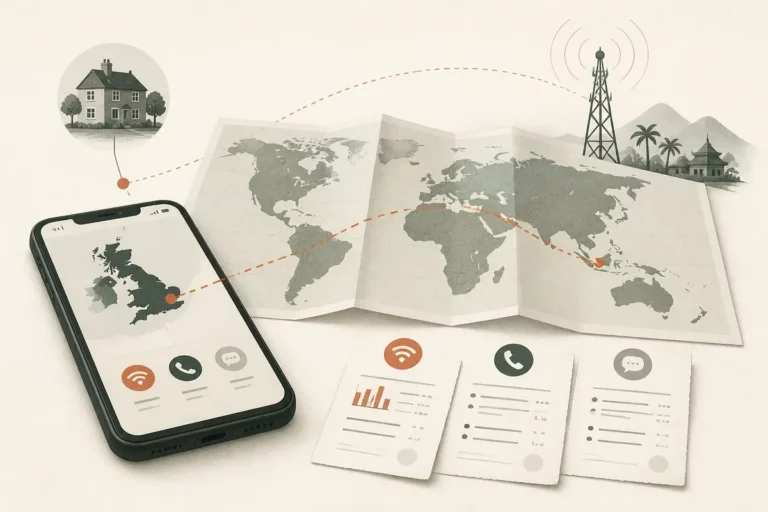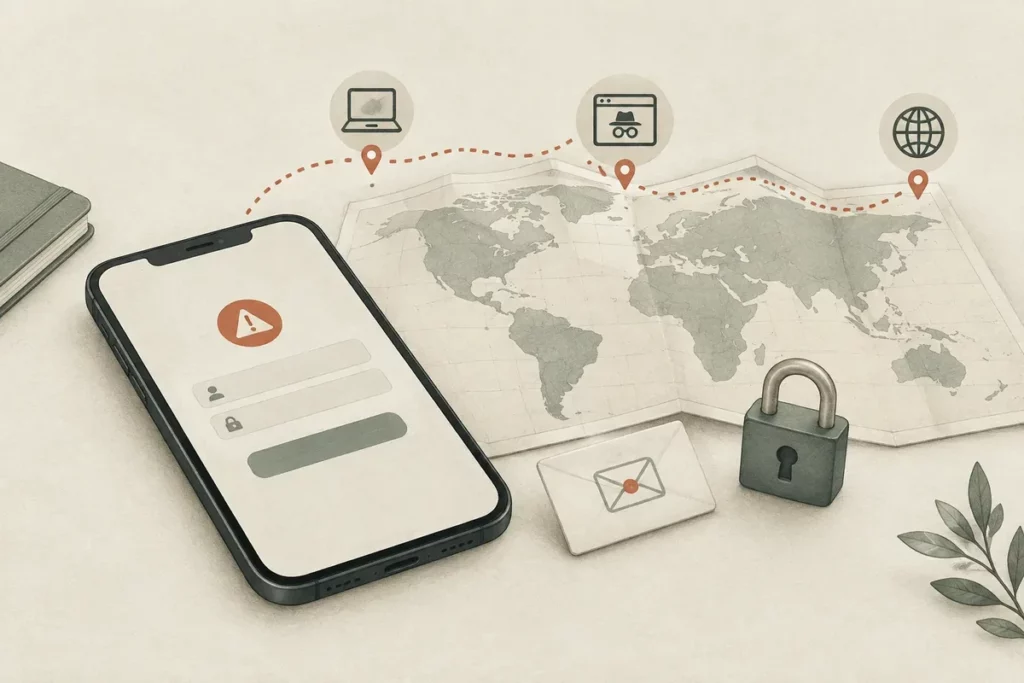
Before you dial, test Alice Mail through the official TIM webmail service with your complete email address, then compare a private browser window, another device, and another network. Match the exact error to the likely cause: credentials or recovery data, browser or application problems, temporary blocking, service disruption, or an account-level security issue.
Alice Mail login problems are not all password failures. An old @alice.it address may be handled within the TIM Mail environment, while a browser loop, an outdated recovery number, or a blocked connection can produce a similar message. Start with the account and provider, then isolate the device, network, and service.
| 🔐 | Complete username: enter the entire Alice Mail address, including its domain. |
| 🌐 | Official access: use the current TIM webmail route rather than an unverified login page. |
| 🧭 | Scope test: compare another browser, device, and network. |
| ⏳ | Temporary block: stop repeated guesses when the service limits attempts. |
| ♻️ | Password recovery: use the provider’s recovery process and verify each ownership check. |
| 🛡️ | Security: never disclose a password or recovery code to an unsolicited contact. |
What Does an Alice Mail Login Problem Actually Mean?
Still, an Alice Mail login problem means that one part of the access chain has failed, not automatically that the mailbox has disappeared. The failure may involve the username, password, recovery route, browser session, application, network, provider service, or account status.
Check the exact message before changing anything. “Incorrect password,” “account not found,” “access denied,” a blank page, and an endless redirect point toward different checks.
Check whether the address is an older Alice Mail mailbox now presented through a TIM Mail environment. That association is reported consistently in the available service information, but the current login and recovery route must be confirmed on the official TIM website.
The visible error is your first diagnostic clue. A password rejection concerns authentication data, while an account-not-found message may indicate a mistyped domain, migration issue, deactivation, or a provider-side lookup failure.
Check the address character by character. An account ending in @alice.it is not interchangeable with an address using another domain, even when the mailbox owner or password is the same.
- Record the exact wording of the error.
- Note whether the page loads normally before rejecting access.
- Check whether the same mailbox works on another connection.
- Separate webmail access from mobile or desktop mail synchronization.
Check the distinction between a webmail login and an email application. Webmail normally asks for the provider’s current sign-in credentials, whereas an application may use separate IMAP, POP3, or SMTP settings and authentication fields.
Why Does Alice Mail Reject My Correct Password?
Still, Alice Mail can reject a password that looks correct when the username is incomplete, autofill has stored an older value, the domain is wrong, or repeated attempts have triggered a temporary security control. Enter the credentials manually once, then stop guessing if the response changes to a block.
Check the complete email address first. Do not enter only the part before the “@” unless the current provider interface explicitly requests that format.
Check the password manually in a private browser window. Autofill may insert an old password, add a hidden space, or select credentials belonging to another mailbox.
Check the keyboard layout and Caps Lock. A password manager can also create a false sense of certainty when it has not been updated after a password change.
Repeated failed logins can lead to a temporary block. Guidance for mail.com describes blocks that usually last a few hours, but that timing belongs to mail.com security controls and must not be treated as an Alice Mail guarantee.
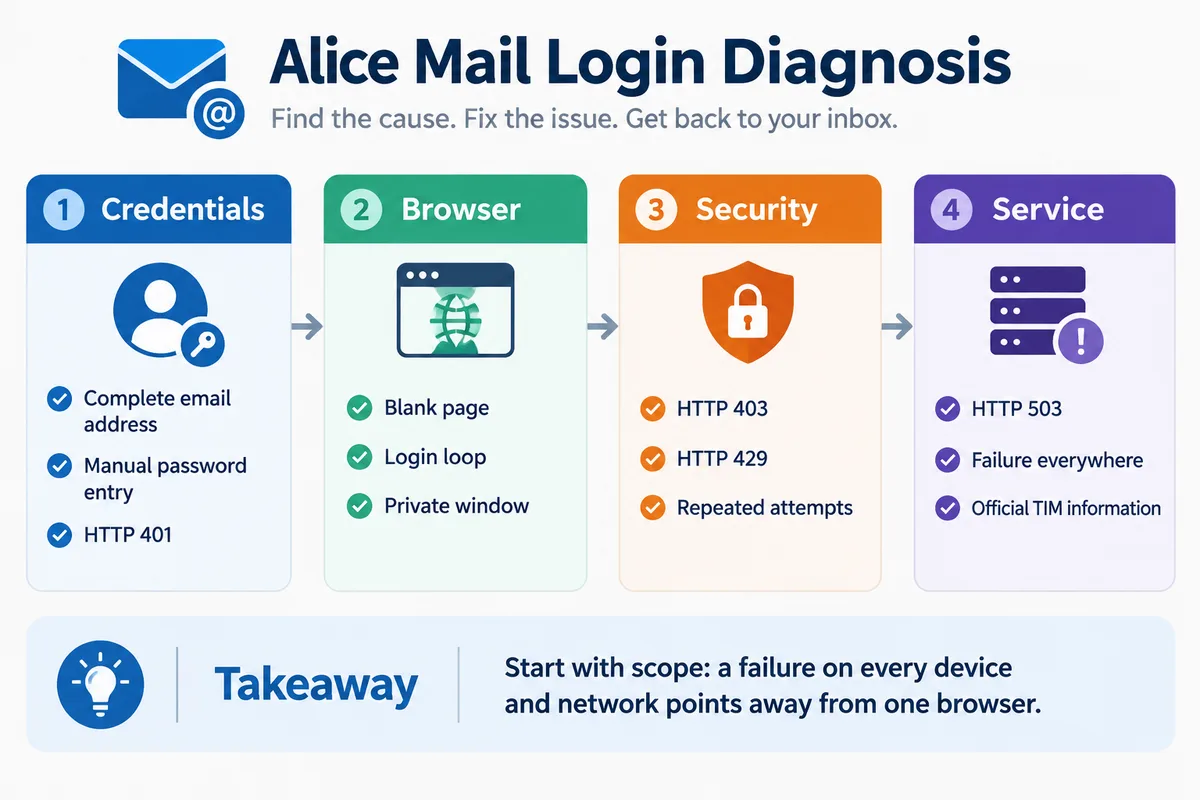
Check the HTTP response when a technical screen exposes one. HTTP 401 means the server did not accept authentication under RFC 9110 section 15.5.2; HTTP 403 indicates that access was refused after the request was processed under section 15.5.4.
| Observed symptom | Most likely area | Next action |
|---|---|---|
| “Incorrect password” | Credentials or autofill | Enter the full address and password manually. |
| HTTP 401 | Authentication | Recheck the address, domain, and password. |
| HTTP 403 | Restriction or block | Stop repeated attempts and check the provider’s security route. |
| HTTP 429 | Too many requests | Wait and do not submit more guesses. |
| HTTP 503 | Service availability | Check official TIM service information later. |
| Blank page or login loop | Browser session | Test private browsing, cookies, cache, and another browser. |
Check the difference between HTTP 429 and HTTP 503. RFC 6585 section 4 uses 429 for too many requests, while RFC 9110 section 15.6.4 uses 503 for temporary service unavailability; the safer response is to stop retrying in the first case and investigate provider availability in the second.
How Can I Reset a Forgotten Alice Mail Password?
Still, a forgotten Alice Mail password should be reset only through the current official provider recovery route associated with the mailbox. The process may ask for a recovery email, phone number, security information, or another ownership check, and rejected details require account verification rather than more random attempts.
Check the official TIM Mail access and assistance pages before entering personal information. A third-party page offering an “instant unlock” or paid recovery service is not a safe substitute for provider verification.
Check the exact mailbox domain in the recovery form. If the address is not recognized, confirm whether the original account is still active, has been migrated into the TIM Mail environment, or has been disabled.
Check the recovery destination carefully. An email may arrive in a different inbox, while a phone-based process may fail because the number is old, unavailable, blocked from receiving messages, or no longer associated with the account.
Use the official recovery form, not a guessed replacement address. Recovery labels and available checks can change, so current instructions on the provider’s own support pages take precedence over old screenshots or forum explanations.
Check the result after a successful reset by signing in through webmail first. Do not immediately configure every phone and desktop application, because a webmail test tells you whether the account credentials work before application settings introduce another variable.
If the reset works on the official page but an application still fails, the password is no longer the first suspect. The application may retain an old credential or use incorrect incoming and outgoing server authentication settings.
Can I Recover Alice Mail Without the Old Email or Phone?
Still, recovery without the old email address or phone number is possible only when the provider offers another ownership-verification route for that legacy account. If no alternative exists, the provider may refuse restoration because bypassing verification would expose the mailbox to account takeover.
Check whether the recovery page offers another method before creating a replacement mailbox. A new address does not restore access to old messages, folders, contacts, or account-linked services.
Check the information you can provide through the official support channel: the exact mailbox address, the approximate account history, the former provider relationship, and details about the last successful access.
Check what the form actually requests. Never send a password, one-time recovery code, full payment details, or unrelated identity documents to an unverified contact.
Check the provider’s current privacy and account-recovery instructions for accepted ownership evidence. The acceptable evidence is controlled by the provider and cannot be safely replaced with a generic list.
A legacy Alice address can also be confused with a deleted or inactive mailbox. The provider must confirm whether it remains active, migrated, or unavailable; a successful password reset is the clearest evidence that the account still exists.
Check the security of every device that previously held the mailbox. If the address, recovery phone, or password changed without your action, treat the situation as possible compromise and use the provider’s account-security route.
What If Alice Mail Says the Account Is Locked, Suspended, or Unknown?
Still, “locked,” “suspended,” and “unknown account” describe different conditions. A temporary security restriction may clear after the provider’s waiting period, whereas an unrecognized address can result from a mistyped domain, migration problem, deactivation, or a mailbox-retention rule that must be confirmed officially.
Check whether the error appears on more than one device and network. If the same message follows the mailbox everywhere, a local browser problem is unlikely.
Check the address spelling, including the domain suffix. One missing character can turn a valid mailbox into an account-not-found response.
Check whether the account was recently accessed through an old application or an unfamiliar location. Suspicious activity controls may block access even when the password is correct.
Do not keep submitting recovery requests when the provider identifies suspicious activity. Repeated requests can add noise to the security review and may prolong the period during which access is restricted.
Check the provider’s current retention and reactivation policy for long-inactive Alice Mail boxes. Do not infer deletion from one failed login, because migration, authentication changes, and temporary security restrictions can produce similar screens.
Check the service from an official TIM route rather than relying on a social-media claim about an outage. If the page returns HTTP 503 across devices and networks, service availability deserves priority over password changes.
What happens after connection? If webmail opens but the application fails, investigate synchronization settings rather than resetting the account again.
Why Am I Not Receiving the Alice Mail Recovery Code?
Still, a missing recovery code usually means that the message went to another destination, a filter intercepted it, the selected recovery method does not match the account, or the code expired. Check delivery paths once, avoid repeated requests, and follow the provider’s stated recovery timing.
Check the recovery inbox, spam folder, blocked-sender list, filters, forwarding rules, and available storage. A message can arrive successfully and still remain invisible because an automatic rule moved it.
Check the phone signal and message-blocking settings when the selected method is an SMS. Do not request a new code repeatedly while the first one may still be delayed.
Check that the code belongs to the current recovery attempt. Older codes may expire when a new request is issued, and entering a previous code can create another verification failure.
Check whether webmail access has returned before troubleshooting missing messages. If login works but incoming mail is absent, the problem has moved from access to folders, filters, synchronization, spam handling, or mailbox capacity.
What Should I Check When Webmail Works but the App Does Not?
Still, successful webmail access proves that the account can authenticate through the browser, not that a mobile or desktop application is configured correctly. The application may contain an old password, an incorrect server name, a wrong port, or an authentication method that no longer matches the provider.
Check the application account settings against the provider’s current documentation. Do not copy IMAP, POP3, or SMTP values from an old forum post without confirming that they still apply to the mailbox and application.
Check whether incoming mail and outgoing mail fail in the same way. IMAP or POP3 concerns retrieval and folder synchronization, while SMTP concerns sending; a working inbox does not prove that outgoing authentication is correct.
Check the application’s saved password separately from the browser’s saved password. Removing and re-adding an account can help, but preserve any unsent messages and local folders before doing so.
Check the phone or computer date, network permissions, VPN, and security software when the application reports a certificate or connection error. These conditions can block a secure connection even when the mailbox itself is available.
For a focused walkthrough of the normal access sequence, see these Alice Mail login steps. If you are comparing the provider environment before changing settings, this Alice Mail service comparison gives the relevant account distinction.
Check the mailbox after webmail access returns. Missing folders may reflect synchronization scope, filters, spam handling, or quota conditions rather than a failed login.
When Should I Contact Official TIM Support?
Still, contact official TIM support when password recovery fails, the mailbox is blocked across devices and networks, the account is unrecognized, recovery details are obsolete, or unauthorized changes appear. Prepare precise evidence, remove secrets, and use the current official contact route rather than an unofficial “live support” number.
Check the official TIM assistance information before calling. For fixed-line customer assistance in Italy, the supplied TIM contact reference identifies 187, but availability, eligibility, and the relevant account department should be confirmed on the current official page.
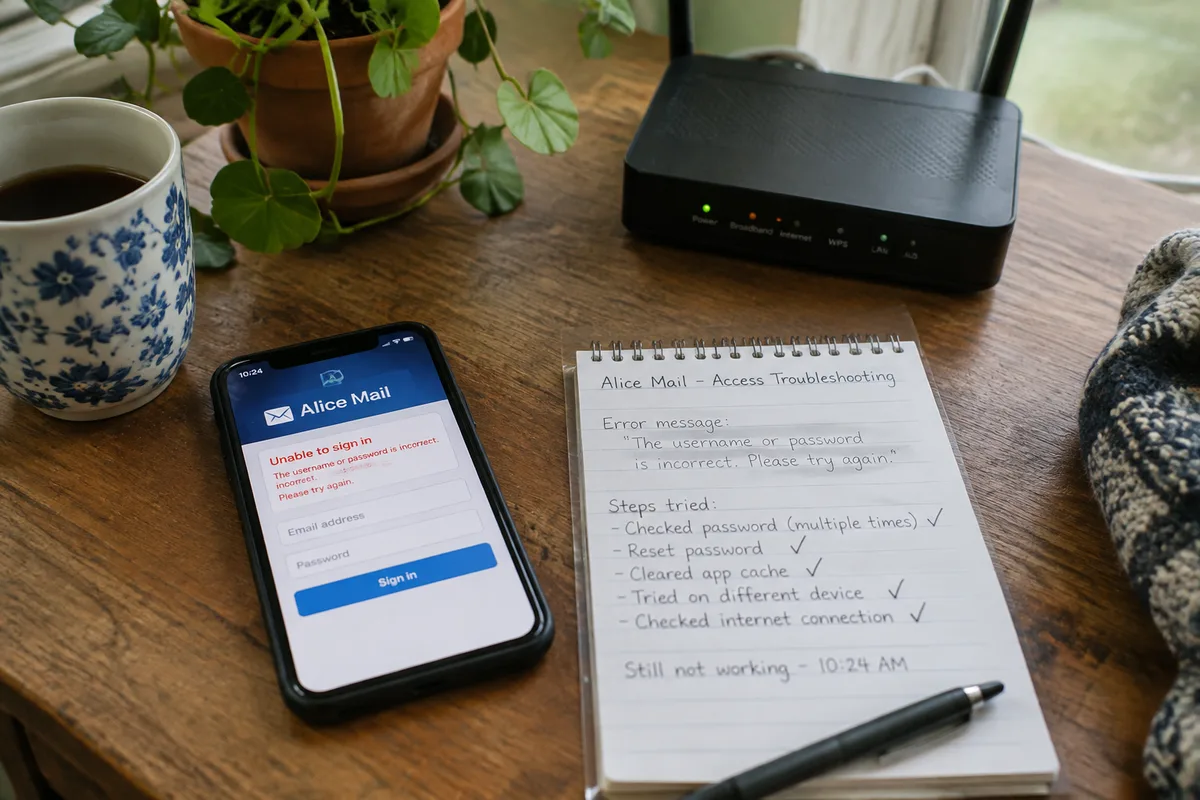
Check these details before opening a support request:
- The complete affected email address, without the password.
- The exact error wording or a screenshot with private data removed.
- The approximate time the failure began.
- The browser, application, device, and network used.
- Whether private browsing, another device, and another network changed the result.
- The recovery steps already attempted.
Check every screenshot for passwords, recovery codes, payment information, and unrelated personal data. Redact those details before sending anything.
Check the support response against the account you actually own. A genuine recovery process should explain the next verification step without asking you to disclose a secret credential.
Check the final result through official webmail before reconnecting applications. Once access works, update the password manager, review recovery contacts, inspect forwarding rules, and remove unknown sessions if the provider offers that control.
Frequently Asked Questions About Alice Mail Access
Who owns Alice Mail?
Alice Mail was originally a consumer email service operated by Telecom Italia, the company now known as TIM. Older @alice.it addresses are therefore associated with TIM’s current mail environment rather than with an independent email company.
How can I recognize a fake Alice Mail recovery message?
A fraudulent message may request your password, recovery code, payment details, or urgent action through an unfamiliar link. Do not provide credentials in response to an unsolicited message, and open the official TIM website by entering its address manually instead of using the message link.
Sources and Safe Verification
Still, current provider instructions take priority because login pages, recovery labels, account policies, and support routes can change. Use the named technical standards for HTTP meanings and official TIM pages for account-specific decisions.
Check these references for the precise point they support:
- TIM Mail assistance pages → current login, recovery, and support routes → use them to verify account-specific instructions.
- TIM customer contacts → current support channels and eligibility → confirm the correct department before sharing account details.
- RFC 9110, sections 15.5.2 and 15.5.4 → meanings of HTTP 401 and 403 → distinguish authentication failure from access refusal.
- RFC 6585, section 4 → meaning of HTTP 429 → stop repeated requests instead of guessing again.
- RFC 9110, section 15.6.4 → meaning of HTTP 503 → investigate temporary service unavailability.
Check the official TIM Alice Mail access assistance before relying on an old tutorial. If the provider does not recognize the address or recovery data, ask support to confirm whether the mailbox remains active, migrated, or unavailable.
Check the cost of delay in practical terms: more password guesses can extend a block, while an unofficial recovery service can expose the mailbox. Use the narrowest safe test, record the result, and dial safely.