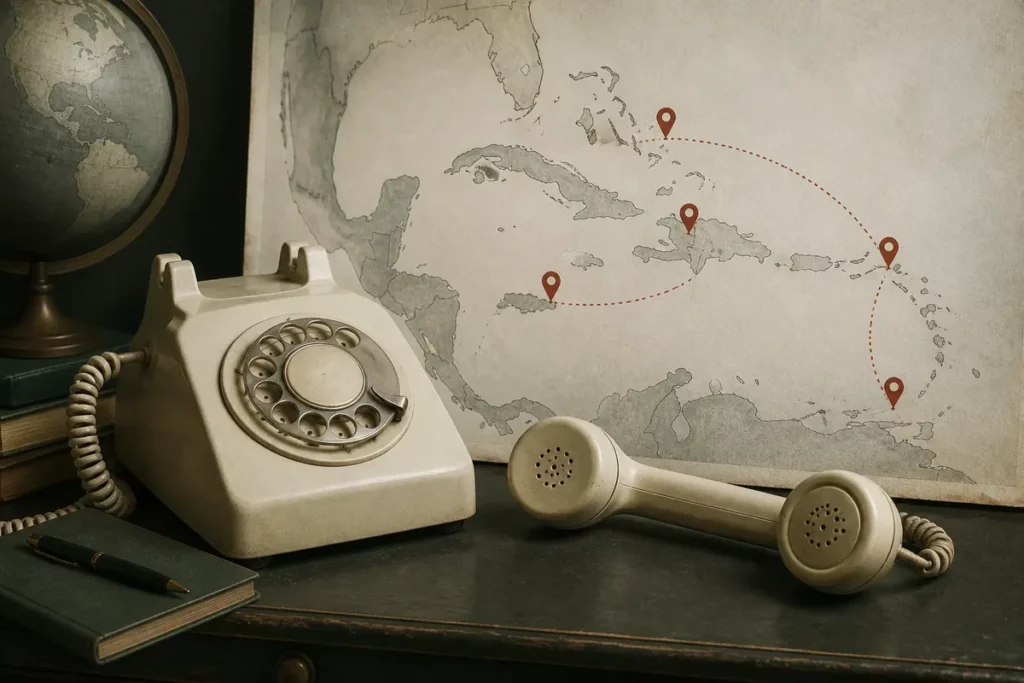
5 area codes you should never answer without checking deserve caution, not automatic rejection: 876, 809, 473, 268, and 649 can appear as ordinary +1 calls while connecting to Caribbean destinations. If you do not recognize the caller, let the call reach voicemail and verify the reason independently before responding.
Caller ID can be spoofed, so an area code identifies a numbering region rather than the person holding the phone. A one-ring call is especially weak evidence of a genuine contact. Returning it may create international or premium-rate charges billed by the minute, depending on the destination, carrier, plan, and roaming status.
| 📞 | 876: Jamaica; confirm unexpected missed calls through a known contact channel. |
|---|---|
| 🌴 | 809: Dominican Republic; urgency and identity claims require independent verification. |
| 🔎 | 473: Grenada, including Carriacou and Petite Martinique; a brief ring proves nothing. |
| ⚠️ | 268: Antigua and Barbuda; reject unsolicited payment or delivery instructions. |
| 🛡️ | 649: Turks and Caicos Islands; verify banks, agencies, and relatives elsewhere. |
| 💳 | Cost: the final callback charge depends on your carrier, plan, destination, and roaming status. |
The 5 Area Codes to Verify Before You Answer or Call Back
However, these five codes are warning signals rather than a blacklist: 876 serves Jamaica, 809 serves the Dominican Republic, 473 serves Grenada, 268 serves Antigua and Barbuda, and 649 serves the Turks and Caicos Islands. All use the +1 country code through the North American Numbering Plan, which can make them resemble ordinary US or Canadian calls.
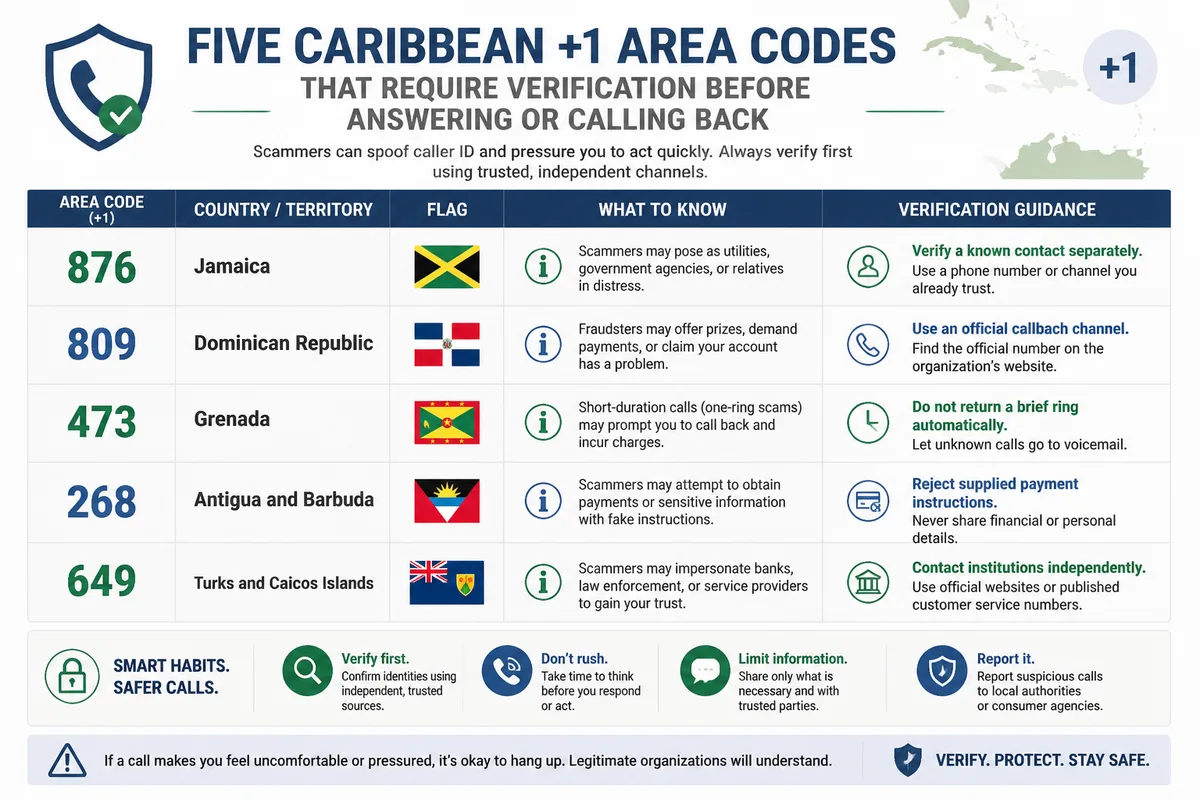
Therefore, the displayed code tells you where the number is assigned, not whether the caller is honest. A legitimate friend, hotel, supplier, or public service could use any code in the list.
The concern begins with the call pattern, not the geography alone. An unsolicited missed call, vague voicemail, urgent demand, or request for a callback deserves a separate check.
Check your carrier’s current international-calling terms before returning a call. A universal price cannot be stated because billing may depend on your mobile plan, roaming status, destination routing, and whether the number reaches a premium service.
Why an Unfamiliar Caribbean +1 Call Can Be Risky
Yet the main risk is usually the pressure to respond, not the act of seeing a Caribbean area code. One-ring or Wangiri-style calls may ring once and disconnect, creating curiosity; a later conversation can then move toward payment, personal data, verification codes, or a costly callback.
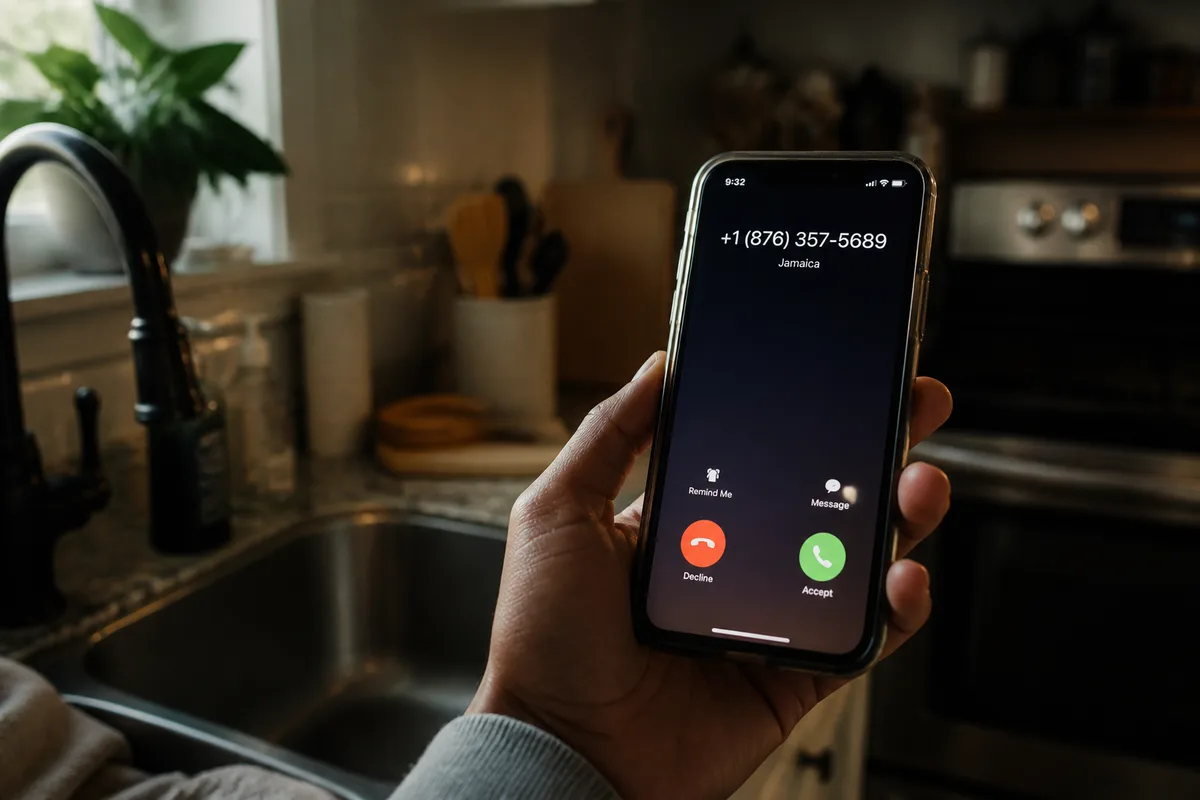
One-ring scams target the callback decision. Some returned calls to international or premium-rate destinations may be billed per minute.
Other scripts use a prize notification, package problem, account alert, family emergency, or fake technical-support request. The caller may ask for a one-time code, bank details, gift cards, remote access, or immediate secrecy.
Answering does not authenticate the caller. A genuine organization should tolerate verification through its published website, existing account, statement, or saved contact record.
- Do not share passwords or one-time verification codes.
- Do not provide bank details or government identification numbers.
- Do not install remote-access software during an unsolicited call.
- Do not use a callback number supplied by the caller as proof of identity.
Traffic pumping is a separate mechanism. It involves high-volume routing arrangements and access charges, whereas a one-ring scam tries to make one person call back.
What Each of the Five Area Codes Means
Nevertheless, each code is best treated as a location clue that needs context. A call becomes more credible when its timing, relationship, voicemail, recent transaction, and independently verified callback number all point to the same legitimate reason.
876: Jamaica
876 serves Jamaica, while 658 is an overlay code in the same numbering area. An unexpected missed call, prize claim, or request to send money remains unverified until a known Jamaican contact confirms it through another channel.
Use a saved number or separate message thread. Do not rely on the incoming call’s identity display.
809: Dominican Republic
809 serves the Dominican Republic alongside the overlay codes 829 and 849. An urgent voicemail does not establish that the caller is a relative, company, or public agency, even when the stated story sounds plausible.
Find the organization’s number on its official website, account application, card, or statement. Call that number yourself.
473: Grenada
473 serves Grenada, including Carriacou and Petite Martinique. A brief ring, silence, or generic message gives you no reliable reason to return the call.
First check whether a trip, supplier, customer, or personal contact explains the number.
268: Antigua and Barbuda
268 serves Antigua and Barbuda. Delivery claims, sweepstakes notices, and urgent financial requests require independent confirmation before any payment, disclosure, or callback.
Reject links and payment instructions supplied by an unsolicited caller.
649: Turks and Caicos Islands
649 serves the Turks and Caicos Islands. A caller impersonating a bank, government agency, business, or relative must be checked through a verified channel before you act.
Use the institution’s published contact details. Never trust urgency as authentication.
For comparison, the distinction between an area code and a country calling code matters when a number is routed internationally; this explanation of area codes and country codes helps separate those two numbering layers.
How to Check an Unfamiliar Number Safely
Thus, the safest sequence is simple: do not rush to answer, inspect the complete number and voicemail, and verify the claimed reason through a new communication channel. Search results and crowd-sourced complaint pages can provide leads, yet they cannot establish who actually called.
-
Let it reach voicemail
When there is no clear reason to answer immediately, allow the caller to explain the purpose.
-
Inspect the context
Check the full number, calling time, voicemail wording, recent transactions, and known relationships.
-
Verify independently
Use an official website, account application, statement, business card, or saved contact record.
-
Protect sensitive details
Refuse passwords, one-time codes, bank information, gift cards, and remote-device access.
-
Block and report
Block repeat nuisance calls and report suspected fraud to your carrier and the relevant consumer-protection authority.
Search the exact number independently if useful, but treat a clean result as inconclusive. Scammers can use new numbers, and legitimate numbers can appear in complaint databases after disputes or mistaken reports.
Do not use the incoming number to verify itself. Open the organization’s official website manually, sign in through the normal application, or contact a trusted person using an established number.
In the United States, the Federal Communications Commission provides guidance for unwanted calls and texts, while the Federal Trade Commission handles consumer fraud information. The FCC also lists 7726 as a carrier forwarding code for reporting many spam messages, subject to provider availability.
For a number that appears to be a normal US geographic code rather than an international destination, a separate 580 area code spam check still requires the same evidence: caller context, voicemail, independent verification, and billing review.
What to Do If You Answered or Called Back Already
Or, if you already answered, focus on what happened next. A brief answer alone does not determine the outcome; the practical response changes if you returned the call, shared a code, gave financial information, installed software, or see an unfamiliar charge.
End the call when the caller requests money, credentials, codes, or urgent secrecy. That is a firm stopping point.
- Review your phone bill or carrier application for unfamiliar international or premium charges.
- Contact the affected bank, service provider, or account owner through a known official number.
- Change exposed passwords, especially where the same password was reused.
- Secure the related account promptly if you disclosed a one-time verification code.
- Save call logs, voicemails, messages, screenshots, and billing details before reporting.
Therefore, answering alone is not a reason to panic. The material facts are whether a callback occurred, whether information was shared, whether remote access was granted, and whether a charge appeared.
In the United States, the National Do Not Call Registry can be reached at 1-888-382-1222, although registration does not eliminate every illegal or unwanted call. For suspected fraud, use current FCC or FTC reporting guidance and your carrier’s abuse channel.
In France, unwanted calls can be reported through the 33700 platform. In Canada, report fraud or cybercrime through the Canadian Anti-Fraud Centre and contact local police when appropriate; the centre lists 1-888-495-8501 for reporting.
Keep the evidence. It helps the carrier, bank, regulator, or police understand the route and the financial impact.
Key Points
- 📍 Area codes identify numbering regions, not trustworthy callers.
- 📵 Let unfamiliar calls reach voicemail before responding.
- 💸 One-ring callbacks can create international or premium billing.
- 🔐 Never disclose codes, passwords, bank details, or remote access.
- 🧾 Save evidence and report suspicious activity through official channels.
Frequently Asked Questions
Are 876, 809, 473, 268, and 649 international area codes?
They are Caribbean numbering-area codes that use the +1 country code within the North American Numbering Plan. A call may still be billed according to your carrier’s international, roaming, or premium-service rules.
Does answering a call from one of these area codes cost money?
Receiving or answering a call does not create one universal charge. The financial risk often increases after a callback, while the final cost depends on your carrier, plan, destination, routing, and any premium service involved.
Can a scammer spoof a Caribbean area code?
Yes. Caller ID spoofing can make a call appear to come from a number that the caller does not control. Verify the person or organization through an independent channel.
What is a one-ring or Wangiri scam?
It is a callback lure in which a call may ring once and disconnect. The aim is to make curiosity or urgency trigger a return call that may reach an international or premium-rate destination.
How can I report a suspicious international call?
Use your mobile carrier’s reporting channel and the relevant consumer-protection authority. US consumers can consult the FCC and FTC; Canadian consumers can contact the Canadian Anti-Fraud Centre, while callers in France can use 33700 for unwanted calls.
Treat these five codes as prompts to verify context and identity, not as proof of fraud; use a separate official channel before calling, and stop if the request feels wrong before calling if something feels wrong.