Before you dial, identify the destination country, the type of number, and your French carrier’s international pricing. To call abroad, use your phone’s international format: an international prefix or plus sign, the destination country code, then the local number, following any country-specific rules. Compare carrier plans, prepaid services, and internet calling apps according to access, reliability, internet availability, and total cost.
The most common mistake is copying a domestic number exactly as written. A leading national trunk prefix may need removal, while a mobile number, landline, toll-free number, or premium number can follow a different rule. The displayed per-minute rate also may not include connection fees, taxes, roaming data, or charges created by the person receiving the call abroad.
The Basic Format for Calling an International Number from France
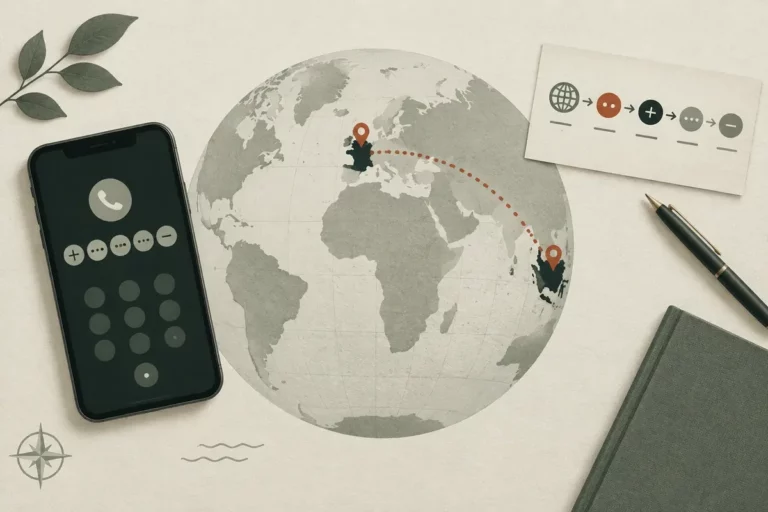
Still, the dialing sequence from France has three functional parts: reach the international network, identify the destination country, and enter the destination number in its international form. On a compatible mobile, the plus sign is usually the clearest notation; on many French networks, 00 serves as the international access prefix.
Check the destination’s official numbering instructions before changing any digits.
Check the number character by character. A country code is not the same as an area code. The country code routes the call to a national numbering system, while an area code or regional code routes it within that country. The remaining digits identify the subscriber. A valid international number follows the destination’s numbering plan, not a generic template copied from another country. Under ITU-T E.164, an international number contains no more than 15 digits, excluding the plus sign and the access prefix. That limit helps identify an obviously malformed number, but it does not prove that the number is active.
Using 00 from a French Landline or Mobile
Still, enter 00 when your French line uses that international access prefix, then add the destination country code and the correctly formatted national number. A landline may display the sequence more clearly, while a mobile can accept it directly if the carrier permits international calls.
Check whether international calling is enabled on the line.
Check the carrier’s current tariff before pressing call. Some plans block international calls by default, especially on restricted, prepaid, business, or child-managed lines. A blocked call usually produces an error rather than a charge, but repeated attempts can waste time. The 00 prefix belongs to the originating network. It does not become part of the recipient’s phone number. Do not save it as though it were the country code.
Using the Plus Sign on a Mobile Phone
Still, the plus sign is the more portable format when you call from a smartphone, because it represents the international access method used by the originating network. Press and hold the zero key on many phones to enter it, then type the country code and international number.
Check the number shown on the confirmation screen.
Check that the phone has not inserted spaces, a second zero, or an old contact format. A saved contact beginning with + and the country code is usually easier to reuse when travelling, although the carrier still controls whether the call is permitted. If the plus sign fails, try the French access prefix only after confirming the operator’s instructions. Plus and 00 are alternative ways to begin the call, not two prefixes to enter together.
A Worked Example Without Assuming Every Country Uses the Same Pattern
Still, use a real destination rule rather than assuming that every country treats its domestic number identically. For example, a French caller contacting a United Kingdom number may need the United Kingdom country code and the national number without its domestic trunk prefix, while another destination can apply a different mobile or area-code rule.
Check the destination’s official number format, not only its country code.
Check a hypothetical contact written domestically as 020 1234 5678 in the United Kingdom. The international version is commonly written as +44 20 1234 5678, because the domestic leading 0 is the national trunk prefix in that format. Treat this as an example of number normalization, not a universal instruction for every country. Country-specific instructions override a general habit. For Mexico, the FCC guidance cited in the supplied material says that callers from the United States or Canada use country code 52 without adding an extra 1; that rule illustrates why a destination-specific source prevails.
How to Find and Use the Correct Country Code
Still, a country code identifies the destination country but does not tell you the complete local number format or the final price. Use an authoritative numbering source, confirm whether the recipient has a mobile or fixed line, and verify the digits after adapting any national trunk prefix required by that destination.
Check the country name and territory carefully.
Check the following compact reference before using a saved contact. The codes are stable examples drawn from the ITU country-code framework, while carrier pricing and local number rules remain separate questions.
| Destination | Country code | What it identifies | What still needs checking |
|---|---|---|---|
| France | +33 | The French national numbering system | The domestic number format and carrier tariff |
| United Kingdom | +44 | The United Kingdom numbering system | Whether the domestic trunk prefix must be removed |
| United States and Canada | +1 | The North American Numbering Plan zone | The area code and the complete subscriber number |
Check the area code separately from the country code. A number beginning with +1 still requires its three-digit area code and subscriber number. A number beginning with +44 still requires the relevant geographic, mobile, or service-number format. Toll-free, premium, satellite, and emergency numbers may be unavailable from France or billed under distinct conditions. They should never be treated as ordinary landlines.
Which Calling Method Fits Your Destination and Budget?
Still, the right option depends on whether the recipient uses a mobile or landline, whether both parties have internet access, and whether predictable billing matters more than convenience. A French carrier is usually the simplest route for an urgent call; an app can reduce the carrier charge when both sides have compatible internet calling, while a local SIM or eSIM suits longer stays rather than a single call.
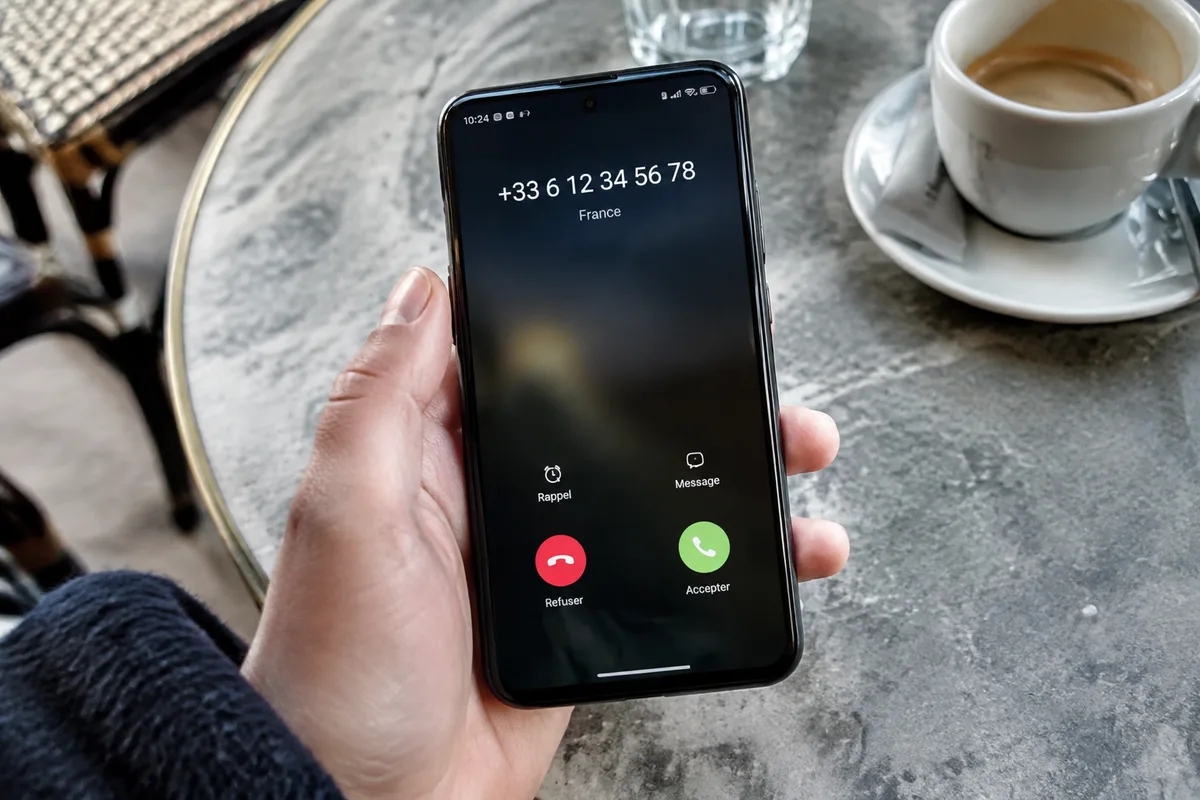
Check the recipient’s access before choosing a service.
Check whether the other person can receive an app-to-app call. Some services require both people to use the same application, while others sell credit for calls to ordinary mobile or fixed numbers. Calling over Wi-Fi can avoid mobile data use, yet the application may still charge for connecting to a conventional phone line. A data-only eSIM can provide internet access without supplying a normal voice number, so it is not automatically a replacement for carrier calling.
Check the total price rather than the advertising label. A carrier plan may charge per minute, apply a monthly fee, or include only selected countries. A prepaid service can make spending easier to control, but unused credit, expiry rules, connection fees, and destination exclusions matter. A VoIP call may be inexpensive while requiring a stable connection; delay, packet loss, or weak Wi-Fi can make a conversation unusable. ITU-T G.114 treats one-way delay below 150 milliseconds as generally acceptable, while delays above 400 milliseconds can make interactive speech difficult.
| Option | Best fit | Main cost question | Main limitation |
|---|---|---|---|
| French carrier | Urgent calls and ordinary phone numbers | Per-minute rate, plan fee, and destination surcharge | Rates may be high for mobile or special numbers |
| Calling app | Internet-connected contacts | Data, subscription, credit, or phone-termination charge | Both parties may need compatible access |
| Prepaid service | Controlled spending for repeated calls | Credit price, connection charge, and expiry | Coverage and number eligibility vary |
| Local SIM or eSIM | Extended travel or local calling | Activation, data, voice, and renewal charges | May provide data without a normal voice line |
Check calling abroad from France before travelling if the call is part of a wider trip-preparation task. That distinction matters: calling a foreign number while physically in France is international calling, whereas using a French SIM after crossing the border can trigger roaming conditions.
How Can You Avoid Unexpected International Calling Charges?
Still, the safest approach is to verify the current carrier tariff for the exact destination and number type immediately before calling. The visible rate may apply only to landlines, exclude mobile numbers, round each started minute upward, or omit connection fees, taxes, and a monthly option.
Check the operator’s official price list for France, the destination country, and mobile or fixed-line status.
- Confirm the country code and local number format.
- Check the rate for a mobile number separately from a landline.
- Look for connection, setup, maintenance, tax, or minimum-charge lines.
- Confirm whether a monthly international option renews automatically.
- Check whether prepaid credit expires or excludes special numbers.
- Disable mobile data roaming when travelling unless the plan clearly covers it.
Check the recipient’s situation too. When someone receives a call while abroad, their operator may charge the incoming call under a roaming tariff; the caller’s French price does not settle that separate cost. The receiving operator’s brochure is the only reliable place to confirm an incoming-call rate. Calling a French number that is currently abroad can therefore create a cost for the recipient even though the caller dialled a French country code.
Check the time zone before calling a business, clinic, or public service. The United States has four main time zones, with New York commonly six hours behind France and the West Coast commonly nine hours behind; seasonal clock changes can temporarily alter that difference. Arizona generally does not observe daylight saving time, except in the Navajo Nation. A successful connection at the wrong hour is still an avoidable failure.
Check the number type if the call fails. Argentina and Australia may restrict international access to some toll-free numbers, and Australian geographic numbers can involve location requirements. Emergency services, satellite phones, premium numbers, and toll-free lines do not necessarily accept ordinary international dialing. Never keep retrying a suspicious number after an unexpected charge appears; review the operator’s call log and contact its official support channel.
Frequently Asked Questions About Calling Abroad from France
How should I write a French phone number for someone calling from abroad?
Replace the initial 0 of the French national number with the French country code +33. For example, 06 12 34 56 78 becomes +33 6 12 34 56 78, while 01 23 45 67 89 becomes +33 1 23 45 67 89. The same conversion does not necessarily apply to French special, premium-rate, or toll-free numbers.
Do I need a country code when calling a French number from another French number?
No. When both caller and recipient are using French numbers within France, dial the usual French national format, including the initial 0. The +33 country code is needed when the call is placed from abroad or when the number is stored in international format.